The Most Expensive Mistake in College Admissions

Every year, thousands of students invest enormous effort into building strong applications, only to apply to the wrong colleges.
They include schools they were never realistically positioned for. They overlook schools where they would have been admitted with merit aid. They build a "balanced list" based on instinct, U.S. News rankings, or a friend's older sibling's experience, rather than on a clear-eyed assessment of how their actual profile aligns with each school's actual standards.
The result is one of the most expensive mistakes in modern admissions: a college list that feels strategic but isn't.
A student with a strong profile applies to twelve schools and gets into one, not because they weren't competitive, but because eleven of those schools were misaligned with their profile in ways no one identified in advance. Another student misses out on substantial merit aid because they never realized a school they considered "below them" was actually their highest-leverage opportunity.
This is not a knowledge problem. Information about colleges is everywhere. It's an alignment problem, and it is the single most overlooked failure point in the entire admissions journey.
The AcceptedX College Search was built to solve exactly this.
In this pillar guide, we'll break down what AcceptedX College Search is, how it works, why it represents a structural shift in how families build college lists, and how students from 9th grade through senior year can use it to transform a list of dream schools into a strategically balanced, deadline-tracked, score-aligned admissions plan.
Why Most College Lists Fail Before Senior Year Begins
Before diving into the College Search itself, it's important to understand why traditional college list-building breaks down, even for highly motivated families.
The Ranking Trap

Most families begin building their college list the same way: with a list of rankings. U.S. News. Forbes. Niche. Princeton Review. They start at the top and work down, picking schools that "feel right" based on prestige, name recognition, or what relatives recommend.
This produces lists that look impressive but are strategically broken. Students apply to eight schools in the top 20 and two schools "as backups", usually chosen with little research and even less alignment. The result is a list weighted toward reaches with safety nets that aren't actually safe.
A college list isn't a hierarchy of prestige. It's a portfolio of probability. And portfolios built on rankings alone produce predictable outcomes: too many rejections, too few acceptances, and a senior spring full of decisions made under pressure rather than strategy.
The Alignment Problem
The deeper issue is that most families have no objective way to measure how their student's profile aligns with each school's standards.
They know their GPA. They know their test scores. They know their extracurriculars. But they have no framework that integrates all of these dimensions into a single, comparable benchmark, one that translates "I have a 3.85 GPA, a 1480 SAT, decent extracurriculars, and a research project" into a clear answer to the most important question in admissions:
Am I actually competitive at this school?
Without that answer, college lists become guesswork. Students apply to schools they were never positioned for and skip schools where they had a real edge. The application strategy collapses before a single essay is written.
The Tracking Problem
Even when a list is built well, the execution layer fails. Application deadlines vary by school and round. Each school requires different essays, different supplements, different recommendation requirements, different financial aid timelines. Students manage this through fragmented spreadsheets, sticky notes, and increasingly desperate emails to counselors.
By November of senior year, even disciplined students are losing track of which schools require which essays, which recommendations have been confirmed, and which deadlines are next. A single missed deadline at this stage can mean a missed acceptance, for reasons that have nothing to do with the student's actual qualifications.
The AcceptedX College Search closes all three of these gaps, discovery, alignment, and tracking, in a single integrated command center.
What Is AcceptedX College Search?
The AcceptedX College Search is an integrated college discovery and application tracking system inside the AcceptedX platform. It combines four powerful functions into one strategic tool: a deep college database, score-based alignment analysis, automatic Safety/Target/Reach categorization, and a complete application tracker.
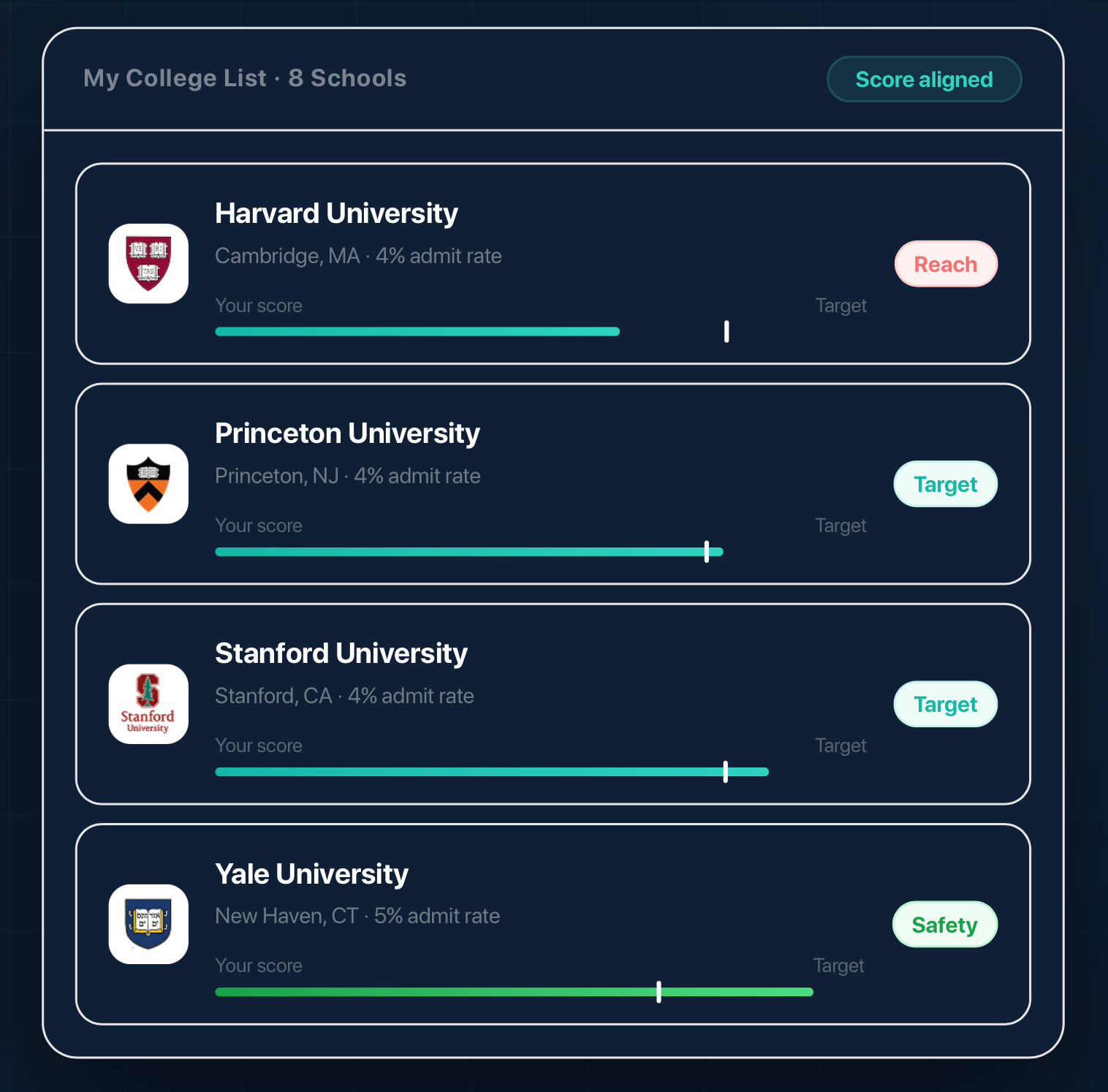
But what makes it fundamentally different from any other college search tool is its connection to the AcceptedX Score, the readiness framework at the core of the AcceptedX platform.
Whereas every other college search tool relies on raw GPA and test score comparisons (a fundamentally incomplete measurement), the AcceptedX College Search measures alignment using a comprehensive readiness benchmark that integrates academics, extracurricular depth, leadership, narrative strength, research positioning, and competitive alignment with each school's actual admissions standards.
In practice, this means:
Discovery is deeper— every school profile shows admissions benchmarks, deadlines, programs, and AcceptedX Score targets in one place
Alignment is precise— students see exactly where they stand against each school, including the specific score gap and the dimensions that would close it
Categorization is automatic— Safety, Target, and Reach are determined by data, not gut feeling
Tracking is unified— every application's status, essays, recommendations, and decisions live in a single dashboard
This is the college search tool reimagined as an admissions command center, not a database, but a full strategic system from discovery to decision day.
The Four Functions That Power a Smarter College List
The AcceptedX College Search is built on four integrated functions that move students systematically from exploration to execution.
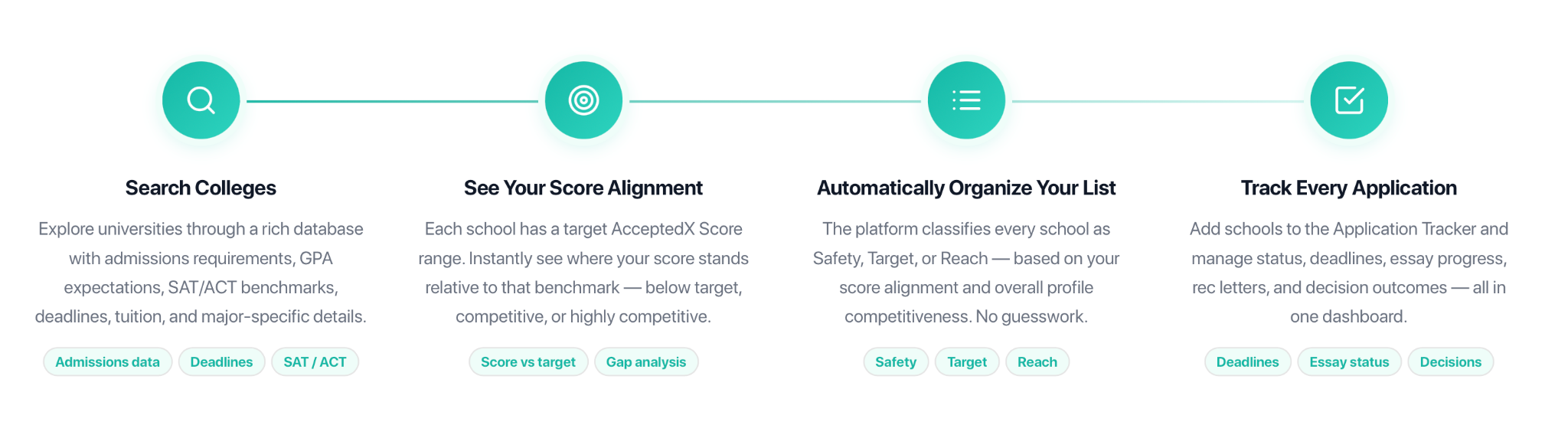
Function 1: Search Colleges
The platform begins with a rich, structured database of universities. Each school profile includes:
Acceptance rate and class profile data
SAT and ACT middle 50% ranges
Average unweighted GPA
Tuition and financial aid context
Key deadlines (Early Action, Early Decision, Regular Decision, FAFSA, Decision Release)
Top programs and majors
Campus setting, undergraduate population, and student life context
Internship access, alumni networks, and career outcomes
This is the discovery layer, but it's structured differently from typical search tools. Rather than presenting raw data and letting students draw their own conclusions, every profile is organized around the decisions students actually need to make: Does this school's profile match mine? Is this deadline workable? Does this school offer my intended major at the strength I need?
A profile for Georgetown University, for example, doesn't just list a 13.5% acceptance rate and a 1400–1560 SAT range. It surfaces those numbers alongside the school's AcceptedX Score target, key deadlines like EA on November 1 and RD on January 10, top programs like International Relations and the McDonough School of Business, and contextual signals like D.C. internship access and a strong alumni network.
This is discovery designed for decision-making, not just browsing.
Function 2: See Your Score Alignment
This is where the College Search becomes uniquely powerful, and uniquely AcceptedX.
Every university in the database includes a target AcceptedX Score range based on its admissions competitiveness. The moment a student adds a school to consideration, they instantly see:
Their current AcceptedX Score
The school's target score
The exact gap between them
Their likelihood category (below target, competitive, or highly competitive)
The specific dimensions that, if improved, would move them into a stronger tier
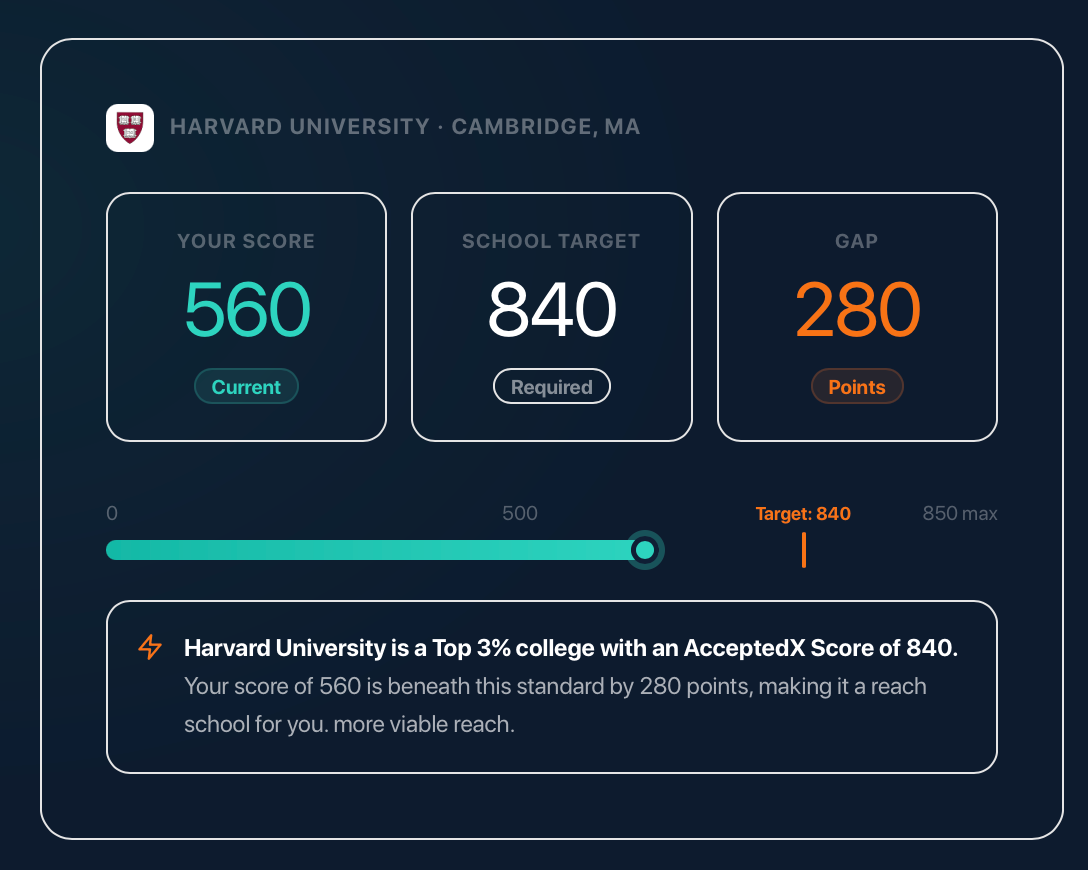
For example, a student with a current AcceptedX Score of 560 considering Harvard University would see Harvard's target score of 840, the 280-point gap between them, and a clear reading that Harvard is currently a reach school. They would also see exactly which dimensions of their profile, academics, research positioning, social validation, leadership, would need to improve to close that gap.
This is the diagnostic clarity most families never get. Instead of "is Harvard a reach for me?" being a vague question discussed at a dinner table, it becomes a precise, data-driven answer with a clear improvement roadmap attached to it.
Function 3: Automatically Organize Your List
Based on score alignment, the platform automatically categorizes every school as Safety, Target, or Reach. This isn't subjective. It's systematic, driven by the gap between the student's AcceptedX Score and each school's target benchmark.
Safety Schools, schools where the student's profile significantly exceeds the benchmark. High-probability admissions outcomes with strong merit aid potential. The platform flags these as opportunities to apply early and apply confidently.
Target Schools, schools where the student's score closely matches or slightly exceeds the target benchmark. These are the highest-impact applications, where strategy and execution matter most. The platform recommends these as the primary admissions focus.
Reach Schools, schools where the student's score is below the target range. Reach does not mean impossible. These schools create a clear roadmap for profile growth, with each one generating a specific improvement plan tied to the AcceptedX dimensions that would move the school into competitive range.
This three-tier classification is what transforms a college list from a hopeful collection into a strategically balanced portfolio. Students no longer apply to twelve reaches and call it a list. They apply to a balanced mix where every school is justified by data, and where every reach has a clear path forward rather than just a hope.
Function 4: Track Every Application
Once the list is built, the College Search becomes the student's full application command center. Every school added to the list flows directly into the Application Tracker, which manages:
Application status across stages (Not Started, In Progress, Submitted, Interview, Decision)
Deadlines for each round (EA, ED, RD)
Essay progress and supplemental requirements
Recommendation letter status (requested, confirmed, submitted)
Interview scheduling and outcomes
Final decisions and scholarship outcomes
A student looking at their dashboard in October of senior year sees exactly where each application stands: two not started, three in progress, two submitted, one with an upcoming interview, and two with decisions already received. Nothing is hidden in spreadsheets. Nothing is forgotten in inboxes. Everything is organized in a single visual dashboard that updates in real time.
This is the layer that prevents the most common cause of last-minute admissions failure: not lack of effort, but lack of organization.
What Each College Profile Actually Captures
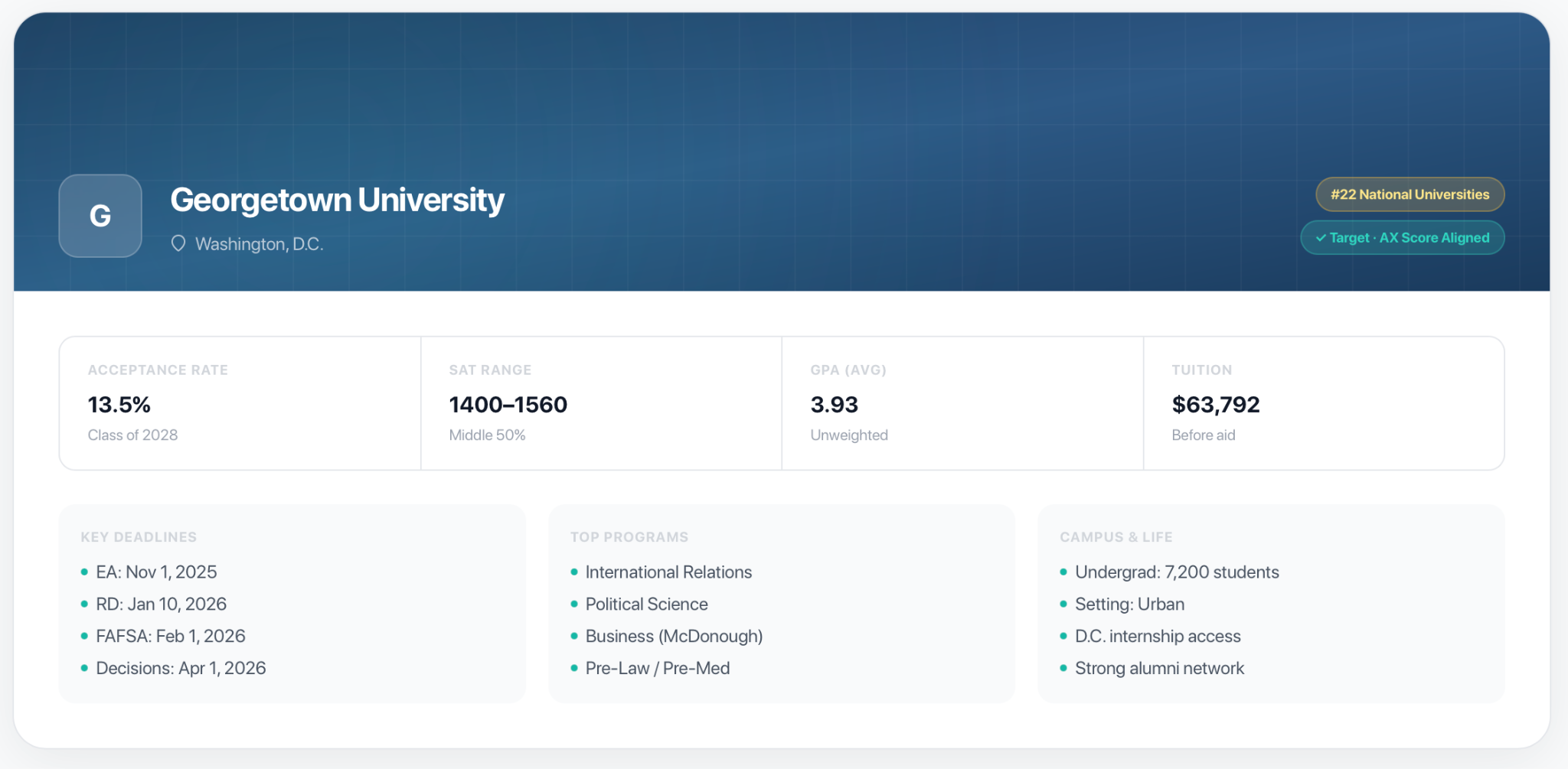
The strength of the AcceptedX College Search is the depth of every individual college profile. Each profile is structured to answer the questions students actually need answered, and to surface them in the order that matters for decision-making.
Admissions Benchmarks
Every profile leads with the data that determines competitiveness: acceptance rate for the most recent class, SAT and ACT middle 50% ranges, average unweighted GPA, and the AcceptedX Score target. This is the foundation of alignment analysis, and it's presented in a way that makes apples-to-apples comparison across schools effortless.
Cost and Aid Context
Tuition is shown alongside aid context, so families can quickly assess affordability before sinking time into an application. For schools known for strong financial aid or merit awards, this context appears prominently, surfacing opportunities that might otherwise be missed.
Critical Deadlines
Every relevant deadline is captured: Early Action, Early Decision, Regular Decision, FAFSA, scholarship-specific deadlines, and decision release dates. This isn't just convenience, it's strategic. Students can compare deadline structures across their list and build an application calendar that distributes effort intelligently rather than collapsing it all into late December.
Top Programs and Academic Strength
Each profile surfaces the school's strongest programs, so students aiming for International Relations see Georgetown's strength clearly, students aiming for engineering see MIT and Caltech's positioning, and so on. This prevents the common mistake of applying to a famous school for a program that isn't actually its strength.
Campus and Life Context
Beyond academics, profiles include undergraduate population, urban or suburban setting, internship access, alumni networks, and other quality-of-life signals that shape four-year experience and post-graduation outcomes.
Together, these dimensions create profiles that are not just informational, they're decisional. Every piece of data exists to help students answer a specific strategic question.
The Real Power of Score Alignment
It's worth spending more time on score alignment, because it's the feature that fundamentally separates AcceptedX College Search from every other tool on the market.
Beyond GPA and Test Scores
Most college search tools tell students whether their GPA and test scores fall within a school's middle 50%. This is useful but incomplete, and at selective schools, dangerously incomplete.
At Harvard, Yale, MIT, Stanford, Princeton, and similar institutions, the vast majority of applicants have GPA and test scores within range. The middle 50% measure tells students almost nothing about their actual competitiveness because the differentiator at these schools is everything beyond academics: research, leadership, narrative strength, social validation, and intellectual depth.
The AcceptedX Score captures all of these dimensions in a single comparable benchmark. When a student sees how their AcceptedX Score aligns with Harvard's target, they're seeing how their full profile compares, not just their academics.
This is the diagnostic depth most families never have access to. And it changes everything about how a college list gets built.
The Improvement Pathway
For every reach school on a student's list, the platform generates a specific improvement plan tied to the dimensions that would close the gap. A student 280 points below Harvard's target doesn't see a vague suggestion to "strengthen their profile." They see exactly which dimensions are weakest, which Library opportunities would address them, and how their AcceptedX Score would change as those gaps close.
This transforms reaches from aspirational guesses into actionable roadmaps. A reach school in 9th grade is a target by junior year, not because the student got lucky, but because the platform provided the precise sequence of actions needed to get there.
The Likelihood Categories
Score alignment also produces clear likelihood categories, below target, competitive, or highly competitive, that map directly to the Safety, Target, and Reach classifications. This is the feature that makes balanced list-building automatic. Students no longer guess at categorization. They see it, with the data behind it visible at every step.
The Application Tracker— Your Senior-Year Lifeline
By the time senior year begins, the College Search transforms into an execution tool. The Application Tracker is the layer that keeps every application moving forward without anything slipping through the cracks.
Status Categories
Applications move through clear status stages: Not Started, In Progress, Submitted, Interview, Decision. At any moment, students can see how many applications are in each stage, and exactly which schools fall into each category.
Real-Time Visibility
The dashboard updates in real time as essays are drafted, recommendations are confirmed, applications are submitted, interviews are scheduled, and decisions arrive. Students never have to reconstruct their status from memory or scattered notes. The full picture is always one click away.
Counselor Integration
Counselors and parents (where authorized) see the same dashboard, which means support conversations happen around real data rather than self-reported summaries. When a counselor asks how Stanford's essay is coming along, the answer is visible, along with what's been completed, what's pending, and what's at risk.
Decision Tracking
As decisions come in, admitted, waitlisted, deferred, denied, they're captured in the dashboard alongside scholarship outcomes. By April of senior year, students have a complete record of their results, which becomes the foundation for the final decision-making process.
This is the layer that makes the difference between a senior year that runs on chaos and a senior year that runs on clarity.
When to Start— From 9th Grade to Senior Year
The most common mistake families make with college search is treating it as a junior or senior year activity. By that point, the strategic windows for many decisions, course rigor, summer programs, score alignment improvements, have already closed.
The AcceptedX College Search is designed to be used iteratively across high school, with each year focused on different strategic questions.
9th and 10th Grade: Exploration
In the early years, students use College Search to explore broadly. They look at schools they're curious about, see how their current profile aligns, and begin understanding which dimensions matter most for the kinds of schools they're drawn to. This isn't list-building, it's calibration. Students learn what selective admissions actually requires before they're locked into senior year.
11th Grade: List Construction
Junior year is when the list starts to take real shape. Students use score alignment to identify which schools are reaches, which are targets, and which are safeties, and then use the improvement plans to begin closing gaps. By the end of junior year, most students have a working list of 10–15 schools with clear strategic positioning for each.
12th Grade: Execution
Senior year is execution. The list is finalized, the Application Tracker becomes the primary workspace, and every application moves through its stages with full visibility. Students apply on time, track every deadline, and finish the year with a complete record of decisions and scholarship outcomes.
This multi-year approach is what separates students who navigate admissions strategically from students who navigate it reactively.
How College Search Connects to the AcceptedX Ecosystem
The College Search doesn't operate in isolation. It is one of six integrated tools inside the AcceptedX platform, each connected back to the AcceptedX Score:
AX Score, the readiness framework that powers school alignment analysis
EssayIQ, the AI-powered essay development engine that handles each school's supplemental essays
Action Plan, the execution roadmap where college list goals become tracked milestones
Library, the curated opportunity engine that surfaces opportunities tied to closing reach school gaps
College Search, the discovery, alignment, and tracking command center
Brag Sheet, the recommendation infrastructure that aligns letters with each target school
This integration is what makes AcceptedX College Search fundamentally different from standalone tools. A change in the Library, say, adding a research opportunity, flows into the Action Plan as a milestone, into the AcceptedX Score as a profile improvement, and into the College Search as an updated alignment with target schools. Every action compounds across the platform.
It is the difference between using a college search tool and operating a complete admissions command center.
Frequently Asked Questions
Is AcceptedX College Search only useful for students targeting Ivy League schools?
No. While College Search is engineered to provide precision at the most selective universities, its frameworks apply to any college admissions journey. Score alignment, list balance, and application tracking matter for state flagships, top liberal arts colleges, specialized programs, and international universities, not just the Ivy League.
How accurate are the AcceptedX Score targets for each school?
Score targets are calibrated based on each school's admissions competitiveness, profile expectations, and historical admissions patterns. They evolve as schools' standards evolve and as the AcceptedX platform refines its benchmarks across thousands of student outcomes.
What if my student's reach schools are too far out of range?
Reach does not mean impossible. Every reach school generates a specific improvement plan tied to the dimensions that would close the gap. A student starting in 9th or 10th grade with a 200-point gap to a reach school often closes that gap entirely by senior year through structured execution. Reaches are starting points, not verdicts.
Can parents see the dashboard?
Yes. Parents have visibility into the college list, score alignment, and application tracker, so they can support their student's journey without becoming the project manager of the process. This is especially valuable for families navigating admissions for the first time.
How is this different from free college search websites?
Free sites are static databases. The AcceptedX College Search is integrated with a personalized readiness framework, a dynamic improvement plan, and a complete application tracker. It doesn't just show schools, it tells students which schools are aligned to them, where the gaps are, and how to close them.
Conclusion: A College List Built on Data, Not Hope
The students who get into top colleges in 2030 will not be the ones who built their lists from rankings and intuition. They will be the ones who built their lists from data, supported by tools that converted raw profile information into precise alignment with each school's actual standards.
The AcceptedX College Search exists to deliver that infrastructure.
It replaces ranking-driven guesswork with score-driven alignment. It replaces vague safety/target/reach gut calls with automatic categorization grounded in real benchmarks. It replaces fragmented application chaos with a unified command center where every essay, every recommendation, every deadline, and every decision lives in one place.
For families navigating one of the most important phases of their child's life, this is the kind of clarity that transforms outcomes. A college list built on data is a college list that produces results, acceptances at schools where the student is a genuine fit, merit aid at schools where their profile justifies it, and a senior spring full of meaningful options rather than missed chances.
Every great admissions outcome begins with a great college list. The AcceptedX College Search is how you make sure yours is built right.
Build your college list. Track every application. Apply with strategy.